 Available in US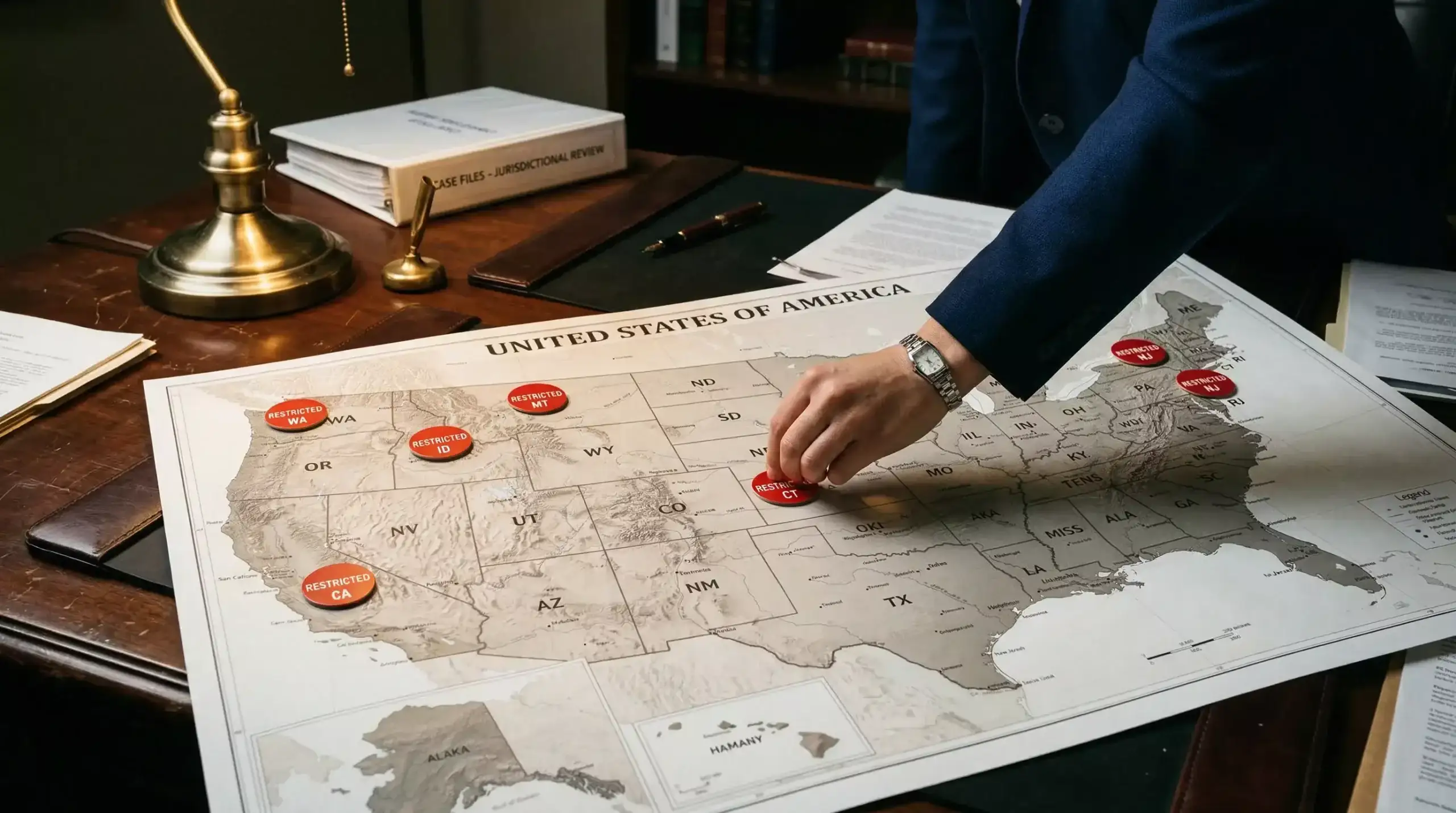
Seven states have banned sweepstakes casinos as of 2026: California, Washington, Idaho, Montana, Connecticut, New Jersey, and New York. Each took a different path to restriction—some through decades-old gambling statutes, others through recent legislation responding to the industry’s explosive growth. The result is the same: players in these states cannot legally access sweepstakes casino platforms, and operators face significant penalties for serving them.
Seven states, seven different approaches. Washington’s ban predates the modern sweepstakes casino industry entirely, rooted in strict gambling laws that leave no room for the dual-currency model. California’s AB 831, by contrast, represents a 2025 legislative response specifically targeting sweepstakes operations. Connecticut went furthest with criminal penalties, while New Jersey focused on protecting its regulated iGaming market. Understanding each state’s approach reveals the varied legal reasoning behind bans—and suggests which other states might follow.
This guide details each banned state’s specific restrictions, penalties, and enforcement approaches. It also covers grey-zone states where sweepstakes casinos face increasing pressure but remain technically accessible. If you’re trying to determine whether sweepstakes casinos are legal where you live, this is the comprehensive reference.
States That Banned Sweepstakes Casinos — More on this topic at sweepstakes legal.
California
California enacted the most significant sweepstakes casino ban in the country through Assembly Bill 831, effective January 1, 2026. The legislation doesn’t merely prohibit sweepstakes casinos—it dramatically increases penalties and extends liability throughout the industry supply chain.
Under AB 831, participating in sweepstakes casino gaming in California carries penalties up to $25,000 in fines and one year in jail. This represents a 2500% increase from previous penalties. The California Senate Public Safety Committee’s analysis of the bill acknowledged these severe penalties while noting that research shows “increased punishments will not deter crime.” Legislators proceeded anyway.
The same analysis highlighted the concerns driving the legislation: “These online sweepstakes games are largely unregulated. Most of the companies offering them are based outside of the United States, meaning essential consumer protections—including age verification and responsible gambling safeguards—are often ignored.”
California’s ban matters because of scale. The state represents approximately 17.3% of the entire US sweepstakes casino market—roughly $2.42 billion in projected 2025 revenue according to industry data. Losing California forced operators to write off their largest single-state market and adjust growth projections accordingly.
Extended liability sets California apart from other banned states. AB 831 explicitly targets payment processors, marketing affiliates, content providers, and geolocation services that support sweepstakes operations. A California-based affiliate earning commissions from sweepstakes casino referrals faces the same criminal exposure as operators themselves. This supply-chain approach creates enforcement leverage that other state bans lack.
Enforcement began in early 2026 with operators geoblocking California players before the effective date. The Attorney General’s office has signaled aggressive pursuit of operators with California connections, with payment processor actions and selective affiliate prosecutions expected.
The broader implications extend beyond California’s borders. Other states considering sweepstakes restrictions now have a template: maximize penalties, extend liability to the supply chain, criminalize rather than merely fine. California’s approach represents the most sophisticated legal framework for eliminating sweepstakes casino access—and other states may simply adopt similar provisions.
The political dynamics that produced AB 831 reveal why California acted so aggressively. Tribal gaming interests wield substantial influence in Sacramento, and they viewed sweepstakes casinos as direct competition taking player dollars that might otherwise flow to tribal properties. Consumer protection concerns provided legislative cover, but the bill’s passage owed much to tribal lobbying.
California’s precedent carries national implications. Other states considering sweepstakes restrictions now have a legislative template. The extended liability provisions, the penalty increases, the definitional changes—all can be adopted by other states without extensive legal drafting. AB 831 may prove more significant as a model than as an enforcement mechanism in its own right.
See also How Sweepstakes Casinos Work.
Washington
Washington banned sweepstakes casinos before the modern industry existed. The state’s gambling laws under RCW 9.46 are among the strictest in the nation, leaving no room for the promotional sweepstakes model that operators use elsewhere.
Unlike states that enacted specific sweepstakes legislation, Washington’s ban flows from comprehensive gambling prohibition. The state defines gambling broadly enough that the dual-currency model—Gold Coins for entertainment, Sweeps Coins for prizes—doesn’t escape classification as illegal gambling. The argument that players don’t pay for prize entries fails under Washington’s legal framework.
Penalties for gambling violations in Washington include Class C felony charges for operating gambling activities, with potential prison sentences and substantial fines. Players face misdemeanor charges. The severity of potential consequences has kept major sweepstakes operators out of Washington entirely—most platforms geoblock the state as a matter of course.
Washington’s approach represents the preemptive model. The state didn’t wait for sweepstakes casinos to become a problem before acting; existing gambling law simply precluded the model from establishing a foothold. This contrasts with states like California that permitted operations for years before legislative response.
The state has licensed tribal casinos and a regulated lottery but has shown no interest in expanding gambling to include online casino-style gaming, whether real-money or sweepstakes-based. Washington players seeking casino experiences must visit physical tribal properties.
For operators, Washington represents minimal opportunity cost. The state’s population of roughly 7.8 million is significant but not market-defining. The combination of strict laws, consistent enforcement, and no pathway to legalization makes investment in Washington access pointless. The state remains blocked and will likely stay that way.
The legal framework in Washington makes the state particularly hostile to any attempt to argue sweepstakes legitimacy. Courts have consistently upheld broad interpretations of gambling law, and the Gambling Commission maintains active oversight. Operators that tried to enter Washington would face immediate regulatory attention and likely criminal referrals. The risk-reward calculation makes the state simply not worth pursuing for any legitimate sweepstakes operator.
Idaho
Idaho maintains a sweepstakes casino ban rooted in conservative gambling policy rather than specific anti-sweepstakes legislation. The state permits tribal gaming under federal compact but restricts most other gambling forms, including the promotional sweepstakes model.
Idaho’s gambling statutes predate modern sweepstakes casinos but are interpreted to cover them. The state defines gambling to include games where prizes are awarded based on chance, and prosecutors have taken the position that sweepstakes casinos—regardless of their dual-currency structure—meet this definition. The “no purchase necessary” argument that works elsewhere hasn’t gained traction with Idaho regulators.
Enforcement in Idaho has been relatively light compared to states with specific sweepstakes legislation. The state hasn’t pursued major actions against operators, instead relying on geoblocking compliance. Most sweepstakes platforms voluntarily block Idaho rather than risk state attention, keeping the market effectively closed without dramatic enforcement actions.
The political environment offers little prospect for change. Idaho’s legislature has shown no interest in gambling expansion, and the state lacks the tribal gaming revenue pressure that drove California’s aggressive approach. Sweepstakes casinos simply aren’t a legislative priority—the ban exists through application of existing law rather than focused attention.
Players in Idaho have limited alternatives. The state has no legal online gambling options, and tribal casinos offer the only in-state gaming. Residents seeking online casino-style entertainment must travel to states where sweepstakes or real-money casinos operate legally.
Montana
Montana’s sweepstakes casino ban combines historical gambling restrictions with recent legislative attention. The state has long maintained tight controls on gambling, permitting limited video gaming machines in bars and taverns but restricting online gambling broadly.
SB 555 addressed sweepstakes casinos specifically, clarifying that the dual-currency promotional model does not exempt operators from Montana’s gambling prohibitions. The legislation removed ambiguity that might have allowed operators to argue their platforms fell outside existing statutes.
Penalties in Montana include misdemeanor charges for players and more serious consequences for operators conducting illegal gambling within the state. The practical effect has been consistent geoblocking—sweepstakes platforms treat Montana as a blocked jurisdiction alongside Washington and Idaho.
Montana shares characteristics with Idaho: a rural, conservative state with limited gambling infrastructure and no evident appetite for online gaming expansion. Both states maintain bans through consistent application of restrictive gambling policy rather than responding to specific sweepstakes industry growth within their borders.
The distinction from larger states is important. California’s ban responded to billions in sweepstakes revenue flowing through the state. Montana’s ban reflects preemptive policy—preventing a market from developing rather than shutting down an existing one. The economics simply aren’t comparable; Montana’s population wouldn’t generate the revenue that made California such a significant loss for operators.
For Montana residents, the gambling landscape remains limited: tribal casinos, limited-stakes video gaming in licensed establishments, and a state lottery. Online alternatives don’t exist within legal boundaries.
Connecticut
Connecticut enacted the most severe criminal penalties for sweepstakes casino operations in the country. Senate Bill 1235 makes operating sweepstakes casinos a Class D felony carrying up to five years in prison and fines up to $5,000—far exceeding the misdemeanor-level penalties in most other banned states.
The severity reflects Connecticut’s unique position. The state legalized regulated iGaming through tribal compacts, creating a licensed online gambling market that sweepstakes casinos directly compete against. Tribal interests and the state’s revenue-sharing arrangements created strong incentive to eliminate unregulated competition. According to Snell & Wilmer’s 2025 analysis, Connecticut’s approach represents the “most aggressive criminal framework” targeting sweepstakes operators.
Connecticut demonstrated willingness to enforce its law early. High5Games, a game studio providing content to sweepstakes platforms, paid a $1.5 million fine following Connecticut enforcement action, according to reporting by the Suffolk Law Journal. This precedent signaled that Connecticut would pursue the supply chain, not just operators—a model California later adopted through AB 831.
The state’s regulated alternatives give context to its aggressive stance. Connecticut residents can access legal online casinos through Mohegan Sun and Foxwoods-affiliated platforms. From the state’s perspective, sweepstakes casinos weren’t filling a gap—they were cannibalizing a regulated market that generates tax revenue and tribal payments.
For players, Connecticut’s ban is unambiguous. Sweepstakes platforms don’t serve the state, and the felony-level penalties for operators ensure compliance continues. Using VPNs to circumvent geoblocking would constitute knowing violation of state law—a risk that makes little sense given legal alternatives exist.
Connecticut’s enforcement history provides a blueprint for other states. The High5Games penalty demonstrated that regulators will pursue entities throughout the sweepstakes supply chain, not just platform operators. Game developers, content providers, and technology vendors all face potential liability. This comprehensive approach makes serving Connecticut commercially untenable for any part of the sweepstakes ecosystem.
New Jersey
New Jersey approached sweepstakes casinos from a position of market protection. The state pioneered regulated iGaming in the United States, launching legal online casinos in 2013 and building a mature market that generates substantial tax revenue. Sweepstakes casinos threatened that investment.
Assembly Bill 5447 established significant financial penalties for sweepstakes operators. According to the legislative text, first violations carry fines up to $100,000. Repeat violations increase to $250,000. These civil penalties complement existing gambling law enforcement mechanisms.
The penalty structure reflects New Jersey’s approach: make sweepstakes operations economically unviable rather than criminalizing participants. Players aren’t targeted with the same severity as California’s model. The focus remains on operators and the business ecosystem supporting them.
New Jersey’s regulated market offers context for its stance. The state’s online casinos generated billions in revenue, with operators like BetMGM, Caesars, and DraftKings competing for market share. These licensed operators pay substantial fees and taxes. From the state’s perspective, sweepstakes casinos were unlicensed competitors taking revenue without contributing to state coffers or complying with regulatory requirements.
The state’s long experience with gambling regulation informed its response. New Jersey understands the gambling industry deeply—it hosts Atlantic City and has managed online gambling longer than any other state. This expertise translated into targeted legislation that addressed sweepstakes specifically rather than relying on general gambling prohibitions.
For players, New Jersey’s ban closes one door while others remain open. Legal online casino options abound. The restriction affects players who preferred sweepstakes platforms specifically, but alternatives exist within the regulated market.
New Jersey’s model shows how iGaming states will likely respond to sweepstakes competition. The combination of existing regulatory infrastructure, tax revenue at stake, and established operator relationships creates natural opposition to unregulated alternatives. Pennsylvania, Michigan, and West Virginia may follow similar paths as sweepstakes casinos grow in those markets—protecting licensed revenue through legislative restriction.
The state’s decade-plus experience with iGaming means enforcement operates smoothly. The Division of Gaming Enforcement understands online gambling intimately and monitors market activity effectively. Operators trying to circumvent New Jersey restrictions face sophisticated regulatory attention, not outdated enforcement frameworks.
New York
New York’s sweepstakes casino crackdown combined legislative action with aggressive enforcement. Attorney General Letitia James made sweepstakes casinos an enforcement priority, issuing 26 cease-and-desist letters to operators in June 2025 according to iGaming Business reporting.
The market impact was substantial. New York represented approximately $762 million in sweepstakes casino revenue in 2024—the second-largest state market after California. Losing New York dealt a significant blow to operators who had built player bases there.
Senate Bill 5935, signed by Governor Hochul in December 2025, formalized restrictions that enforcement actions had signaled. The legislation clarified that sweepstakes casinos violate New York gambling law regardless of their dual-currency structure, imposing penalties of $10,000 to $100,000 per violation. The promotional sweepstakes argument that works in other states doesn’t satisfy New York authorities.
New York’s approach differs from other banned states in its enforcement-first character. Rather than waiting for legislation to pass, the Attorney General acted under existing law, interpreting sweepstakes casinos as illegal gambling and pursuing operators accordingly. Legislation followed to solidify the legal framework and remove any ambiguity operators might exploit.
The state’s gambling landscape is evolving. New York legalized mobile sports betting in 2022 with strong revenue results. Online casino legalization has been debated but not enacted. Tribal casinos and commercial casinos operate throughout the state. Against this backdrop, sweepstakes casinos represented unregulated competition that generated no tax revenue and operated without state oversight.
Enforcement continues. Players report geoblocking from major sweepstakes platforms, and the AG’s office has indicated ongoing monitoring for compliance. Operators who ignore New York’s restrictions face enforcement action and substantial penalties.
New York’s pattern—enforcement first, legislation second—may influence other states. The approach demonstrates that existing gambling law can address sweepstakes casinos without waiting for specific statutory amendments. State attorneys general watching New York’s success may pursue similar strategies, accelerating restrictions without legislative timelines.
The loss of New York compounds California’s impact. Together, these two states represented roughly a quarter of the total US sweepstakes casino market. Operators losing access to both face significant revenue reductions that affect investment capacity, marketing budgets, and overall business viability. The cascade effect of losing major markets extends beyond direct revenue loss.
New York’s approach may influence other states considering action. The enforcement-first model—acting under existing law while pursuing legislation—allows faster results than waiting for legislative processes. States with ambiguous laws but hostile regulators can follow New York’s playbook: cease-and-desist first, legislation second.
Grey Zone States
Beyond the seven states with clear bans, a growing number of jurisdictions occupy regulatory grey zones—taking enforcement actions against sweepstakes casinos without enacting formal prohibition legislation. These states create uncertainty for both players and operators.
Illinois exemplifies the grey-zone approach. According to Gambling Insider’s 2026 tracking, the Illinois Gaming Board, in coordination with the Attorney General’s office, issued 65 cease-and-desist letters to sweepstakes operators in February 2026. Only about 3% of targeted operators complied within the first two weeks. This enforcement pressure signals clear disapproval without creating statutory prohibition. Players technically might access some platforms, but the regulatory environment suggests escalating risk.
Florida’s situation is similarly ambiguous. According to Florida Senate Bill Analysis, the state received over 2,000 complaints about illegal gambling operations in 2023-2024, many involving sweepstakes-style platforms. Enforcement actions have occurred, but comprehensive legislation hasn’t passed. The market remains partially accessible while operators face escalating pressure.
Other grey-zone states include Nevada, where some operators voluntarily geoblock to avoid complications with the Gaming Control Board, and Michigan, where regulated iGaming creates similar dynamics to Connecticut and New Jersey. These states haven’t enacted sweepstakes-specific bans but create operational risk through existing gambling frameworks.
For players in grey-zone states, the practical advice is caution. Platforms may be accessible today and blocked tomorrow. Cease-and-desist letters don’t immediately close access but signal direction. The safest assumption: if a state’s attorney general is actively pursuing sweepstakes operators, eventual restriction is likely even if current access continues.
Operators treat grey-zone states as elevated risk. Some continue serving these markets while monitoring regulatory developments. Others proactively geoblock to avoid enforcement attention. Player access can change quickly based on operator decisions or state actions.
The grey zone itself represents a moving target. States can move from accessible to restricted rapidly when enforcement actions escalate or legislation passes. Operators increasingly adopt conservative positions, blocking states at the first sign of regulatory attention rather than waiting for formal prohibition. From a player perspective, grey-zone access is temporary access—enjoy it while it lasts, but expect eventual restriction.
State-by-state variations within the grey zone matter. Some states have sent cease-and-desist letters but taken no further action. Others have pursued fines or injunctions. The intensity of enforcement signals how close a state sits to formal prohibition. Players monitoring regulatory news can anticipate which grey-zone states are likeliest to join the banned list.
Understanding the Landscape
Seven states have banned sweepstakes casinos through varied mechanisms: California through aggressive new legislation, Washington through longstanding gambling law, Idaho and Montana through conservative gambling policy, Connecticut through felony-level criminal penalties, New Jersey through financial sanctions protecting iGaming, and New York through enforcement-first crackdowns.
The pattern suggests more restrictions are coming. States with tribal gaming interests, established iGaming markets, or general gambling hostility have clearest motivation to act. States that legalized sports betting but not iGaming face political pressure from tribes and existing gambling operators who view sweepstakes casinos as unfair competition.
Seven states introduced sweepstakes-related legislation in 2025 alone, according to Snell & Wilmer’s analysis: New Jersey, Mississippi, Maryland, Connecticut, New York, Nevada, and Florida. Not all resulted in bans, but the legislative attention signals broadening concern among state lawmakers.
For players, the map of banned states determines access, but grey-zone developments matter too. A state that sends cease-and-desist letters today may pass formal prohibition legislation tomorrow. Checking current platform availability before assuming access continues is prudent.
The sweepstakes industry, despite bans in seven states, remains accessible in the majority of the country. Over 40 states still permit sweepstakes casino operations, serving tens of millions of players. The lost markets—particularly California’s $2.42 billion—hurt operators significantly but haven’t eliminated the industry. Whether the regulatory trend continues toward more restrictions or stabilizes at current levels remains unclear as 2026 progresses.
The safest approach for players: verify your state’s current status before playing, understand that access can change quickly, and avoid attempting to circumvent geoblocking through VPNs or other methods. The legal consequences in banned states—ranging from fines to potential criminal charges—aren’t worth the risk.
This guide provides general information about state restrictions on sweepstakes casinos. It is not legal advice. Laws change, and enforcement varies. Check current platform availability and consult legal counsel for specific questions. Information current as of March 2026.