 Available in US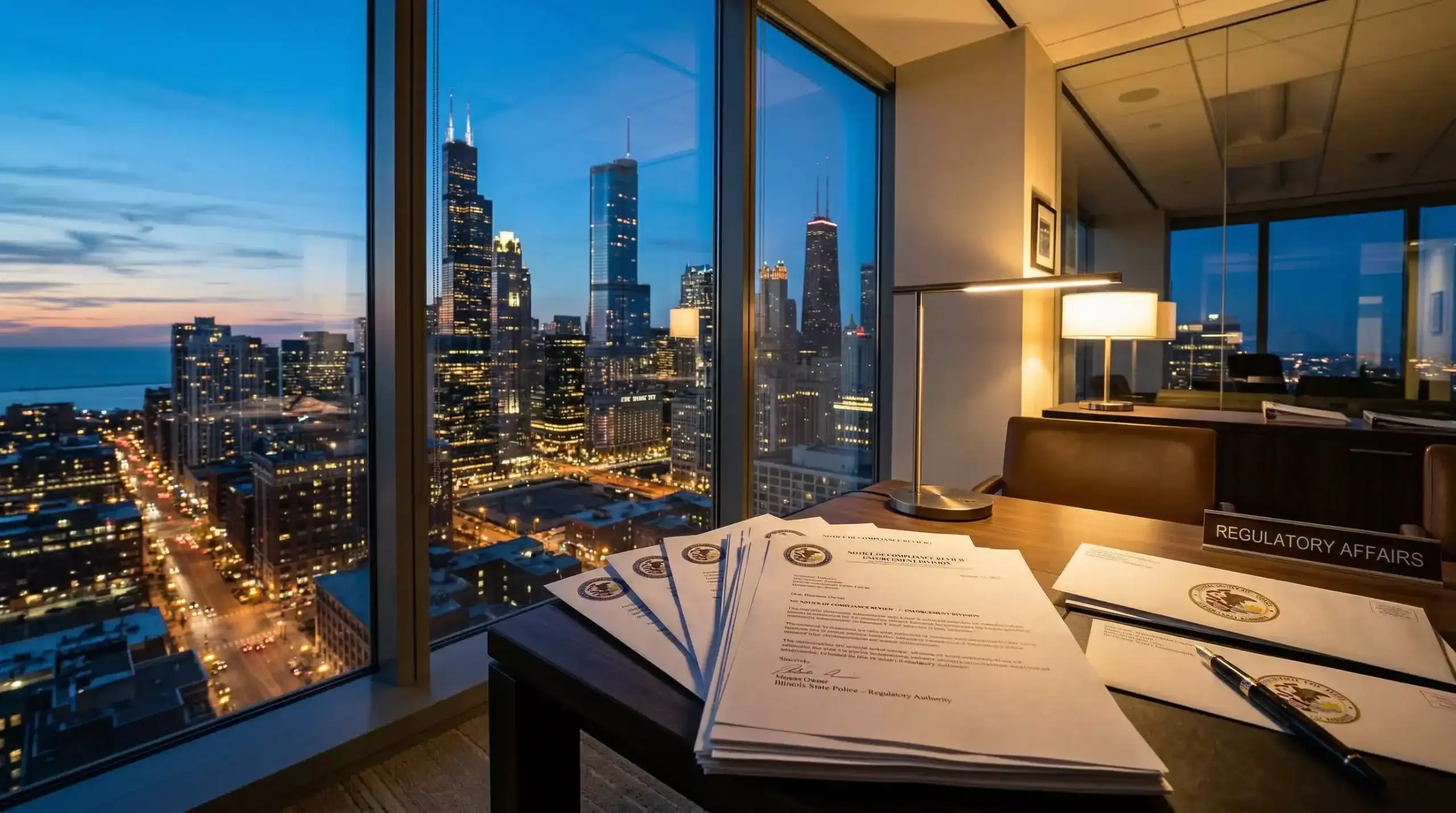
Illinois launched one of the most aggressive sweepstakes casino enforcement campaigns in the country when the Gaming Board, in coordination with the Attorney General’s office, issued 65 cease-and-desist letters to sweepstakes operators in February 2026. This campaign exceeded even New York’s 26-letter effort and established Illinois as a hostile jurisdiction for sweepstakes casino operations—though without the explicit legislative prohibition that states like California have enacted.
The Illinois action represents the cease-and-desist approach to enforcement at its most intensive. Rather than waiting for legislation to pass, the Attorney General took action under existing gambling statutes, asserting that sweepstakes casinos already violate Illinois law. This creates a gray zone where operators face clear regulatory hostility without absolute legal prohibition, leaving player access uncertain and operator compliance decisions complicated.
Understanding Illinois’s enforcement position helps players in the state assess their access situation and helps industry observers track how cease-and-desist strategies perform compared to legislative approaches. As Dan Hartman, former Colorado Division of Gaming director, has observed, operators “can’t all break in through the backdoor”—and Illinois is now actively pushing back against those who tried.
The Attorney General’s Actions
The Illinois Gaming Board (IGB), in coordination with Attorney General Kwame Raoul’s office, initiated the cease-and-desist campaign as an enforcement action under existing Illinois gambling law. The letters demanded that 65 sweepstakes casino operators immediately stop serving Illinois residents, stop advertising to Illinois audiences, and stop processing transactions from Illinois customers. Non-compliance, the letters warned, would result in civil and potentially criminal enforcement proceedings. IGB Administrator Marcus D. Fruchter stated: “Illegal online gambling operations threaten consumer protections, undermine responsible gaming safeguards, and are antithetical to the public’s interest in regulated gaming.”
The legal basis for the letters rests on the Illinois Criminal Code provisions governing gambling. The Attorney General’s position is that sweepstakes casinos—despite their promotional structure—constitute gambling operations under Illinois law because they offer prize opportunities based on chance. The dual-currency model doesn’t eliminate the gambling classification, according to the state’s interpretation, because players can still redeem winnings for cash value.
The campaign’s scope was remarkable. Sixty-five operators represents essentially the entire active sweepstakes casino industry serving Illinois. Major platforms like Chumba Casino and Pulsz received letters alongside smaller operators. The comprehensive approach signaled that Illinois wasn’t targeting individual bad actors but treating the entire sweepstakes casino model as problematic under state law.
Enforcement mechanisms available to the Attorney General include civil lawsuits seeking injunctions and penalties, referral to local prosecutors for criminal charges, and coordination with payment processors and financial institutions to disrupt sweepstakes casino transactions. The letters made clear that the state has multiple tools available if operators don’t comply voluntarily.
Illinois Sweepstakes Casino Crackdown — More on this topic at sweepstakes legal.
The Gray-Zone Status
Illinois’s approach creates a peculiar regulatory status—sweepstakes casinos aren’t explicitly legal, but they aren’t explicitly illegal through specific legislation either. The Attorney General has taken a position on existing law’s application, but courts haven’t definitively ruled on whether sweepstakes casinos actually violate Illinois gambling statutes.
This gray-zone status differs from states with explicit prohibitions. California’s AB 831 leaves no ambiguity—sweepstakes casinos are clearly illegal as of January 2026. Illinois’s situation requires operators to assess whether the Attorney General’s interpretation would prevail in court and whether the risk of litigation justifies continued service. Different operators have reached different conclusions.
The ambiguity affects enforcement leverage. Operators who believe their services comply with Illinois law might choose to continue operating and defend their position if sued. The Attorney General would then need to pursue litigation rather than simply enforcing a clear prohibition. This litigation path is more resource-intensive and outcome-uncertain than enforcement under explicit statutory bans.
For players, the gray zone means access may continue even after cease-and-desist letters. Some platforms have implemented Illinois geoblocking in response to the letters; others continue serving Illinois residents while assessing their legal options. The result is inconsistent access—some platforms blocked, others available—that creates confusion about what’s actually accessible from Illinois.
See also Nevada Sweepstakes Casinos.
Operator Response
Sweepstakes casino operators have responded to Illinois enforcement with varying strategies. The range of responses reflects different risk assessments, market calculations, and legal perspectives on the strength of Illinois’s position.
Some operators implemented immediate Illinois geoblocking. Platforms that prioritize regulatory relationships and risk minimization concluded that any revenue from Illinois wasn’t worth the enforcement exposure and potential reputational damage from prolonged conflict with a major state’s attorney general. These platforms no longer accept Illinois registrations or serve existing Illinois accounts.
Other operators continue serving Illinois while engaging in dialogue with regulators. These platforms may believe their services comply with Illinois law, may be gathering information before deciding on compliance strategy, or may be calculating that enforcement resources will focus on more vulnerable targets. Continued operation isn’t necessarily defiance—it may reflect genuine disagreement about legal interpretation.
Industry associations have advocated for regulatory clarity. The Social Gaming Leadership Alliance and other industry groups have argued that cease-and-desist enforcement without legislative specificity creates uncertainty that harms both operators and consumers. These groups prefer either explicit legislative frameworks—ideally licensing paths that would allow regulated operation—or clear judicial determination of the existing law’s application.
Legal challenges remain possible. Operators who receive enforcement actions beyond cease-and-desist letters could contest the Attorney General’s interpretation in court. Such litigation would produce precedent clarifying whether sweepstakes casinos violate Illinois gambling law or fall outside its scope. Until such litigation occurs, the legal question remains technically unresolved despite the Attorney General’s clear position.
Player Access Impact
Illinois players face an evolving access landscape that varies by platform and continues changing as operators respond to enforcement pressure. Understanding the current situation helps players make informed decisions about their participation.
Platform availability is inconsistent. Some sweepstakes casinos have blocked Illinois entirely; others continue accepting Illinois players. Checking current availability requires attempting registration or login—status from weeks ago may no longer be accurate as operators update their geographic restrictions. Players should verify access directly rather than relying on outdated information.
Legal risk for players remains minimal but not zero. Illinois gambling law focuses enforcement on operators rather than individual players, and the Attorney General’s campaign targeted platforms, not consumers. However, players using platforms that have received cease-and-desist letters operate in a space the state has identified as problematic. Personal legal exposure is unlikely but can’t be entirely ruled out.
Account management becomes important for players with existing balances on platforms that may block Illinois. Operators that implement geoblocking sometimes allow existing players to redeem accumulated Sweeps Coins before losing access. Players with significant unredeemed balances should consider whether to redeem proactively rather than risk access disruption that complicates withdrawal.
Future access is uncertain. The enforcement campaign may evolve toward litigation, legislation, or settlement arrangements that affect which platforms operate in Illinois and under what conditions. Players should treat current access as potentially temporary and avoid becoming dependent on sweepstakes casino entertainment that may become unavailable.
What Illinois Signals
Illinois’s cease-and-desist campaign demonstrates that states can apply significant enforcement pressure without new legislation. The Attorney General’s office used existing gambling statutes to take action, interpreting those laws to cover sweepstakes casinos despite the promotional model’s claimed exemption. This approach provides a template for other states considering sweepstakes casino restrictions.
The campaign’s effectiveness will be measured over time. If operators largely comply and Illinois access diminishes, the cease-and-desist model proves viable for states wanting to restrict sweepstakes casinos without legislative battles. If operators resist and enforcement becomes entangled in litigation, the model’s limitations become apparent and legislative approaches may prove more reliable.
For the sweepstakes casino industry, Illinois represents another major market facing serious access uncertainty. Combined with California’s explicit prohibition, New York’s enforcement campaign, and restrictions in other states, the Illinois situation contributes to a geographic contraction that shows no signs of reversing. The industry’s accessible market continues shrinking even as demand in remaining states persists.